
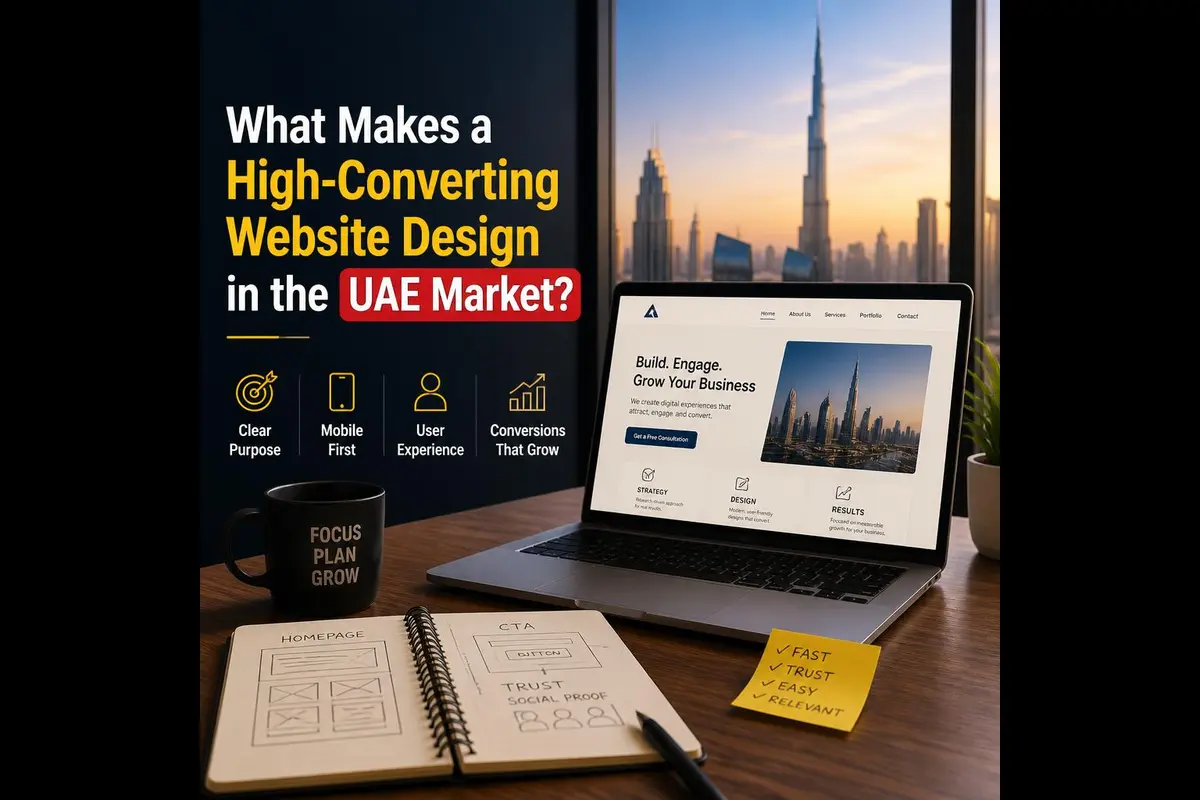
What Makes a High-Converting Website Design in the UAE Market?
A website can look impressive and still fail to bring in sales and bookings. Good visuals may encourage visitors to stay for a few seconds, but conversion depends on what happens next.
- Can they understand what the business offers?
- Can they find the information they need?
- Is it easy to contact the company or complete a purchase?
These questions become especially important in the UAE, where websites often serve audiences from different countries and cultural backgrounds. A good website design can help you attract local customers alongside tourists and international buyers.
For that reason, a high-converting website needs to make the next step obvious while giving visitors enough confidence to take it. Keep reading to learn the key factors that make a great website design.
How To Increase Your Website Conversion Rates in the UAE Market
Did you know that 94% of first impressions are shaped by the website design?
The UAE online business market is projected to reach $21 billion by 2031, and the absence of a great website design ultimately means that you are missing out on a lot of opportunities.
This is the reason businesses are rapidly investing in corporate website design service Dubai.
Here is how you can impress your visitors and hook them onto your website in the first go.
Understand Who the Website Is Speaking To
You need to understand the audience before doing anything else.
- A Dubai-based restaurant, for example, may serve residents and office workers.
- Whereas a real estate company may target investors from several countries.
- On the other hand, an online retailer could have customers across the UAE with very different buying habits.
The website should reflect those differences without becoming confusing.
Clear language, familiar terminology, relevant imagery, and straightforward navigation can help visitors recognize that the website is meant for them.
The same principle applies to the information presented. A visitor looking for a service should not have to search through several pages before finding pricing information or contact options.
Make the First Few Seconds Count
Setting an impression shouldn’t mean that your homepage needs elaborate animations or an oversized visual design.
It means the first section should communicate the essentials without making people work for the information.
A strong opening section normally makes three things clear:
- It tells visitors what the business does without relying on vague marketing language.
- Will explain the problem the service addresses in terms the target customer can understand.
- It also provides an obvious action, such as requesting a quote or calling the business.
A visitor should have a reasonable idea of what the company offers before scrolling through the entire page.
Build for Mobile Visitors
Stats suggest that over 72%–75% of web browsing in the UAE comes from mobile phones.
People in the UAE regularly use smartphones to search for restaurants, property listings, travel options, and local businesses.
A mobile-friendly website should have readable text, buttons that are easy to tap, properly sized images, and menus that do not take up unnecessary space.
Forms deserve particular attention because nobody wants to fill out a long form on a small screen. Asking only for information that is genuinely needed can make the process less frustrating.
Use Trust Signals Where They Matter
A visitor may like a service but still hesitate before making contact. This is where trust signals can help reduce that hesitation.
UAE businesses can use genuine customer reviews, testimonials, case studies, and recognizable payment or security indicators where relevant.
The placement matters too.
For example, a testimonial near an enquiry button can reinforce confidence at the moment someone is considering taking action.
Remember, a well-structured website can also complement detailed company profiles by giving potential clients a quick way to explore your business online.
Keep Navigation Simple
Good navigation is often invisible when it works properly.
Your visitors should be able to move from one section to another without wondering where to click next. A cluttered menu can make even a well-designed website feel difficult to use.
For most businesses, the navigation should give priority to pages that help people make decisions.
Depending on the business, these may include:
- Services or products.
- About the company.
- Pricing or packages.
- Portfolio or previous work.
- Contact details.
- FAQs or useful information.
The exact menu will depend on the industry, but the principle remains the same: important information should not be buried.
Make Calls to Action Easy to Find
Your website should not make visitors guess what they are supposed to do; this is why the calls to action should match the purpose of the page.
- A service page might encourage visitors to request a consultation
- On the other hand, a product page may focus on adding an item to a cart.
Using the same call to action everywhere can also weaken the user experience because each stage of the buying process requires different actions.
Someone comparing providers may want a quote, whereas a visitor who has already made a decision may simply want a phone number or booking form.
Create Content That Answers Real Questions
Your website copy should help visitors make decisions rather than fill empty spaces on a page.
For UAE businesses, useful content can address questions about pricing, service areas, delivery, appointment availability, payment methods, timelines, warranties, returns, or the process involved.
This can also support search visibility because people often use specific questions when looking for local services.
Instead of writing several paragraphs about being “committed to excellence”, you can explain exactly what happens after a customer submits an enquiry.
That information is more useful and gives visitors a clearer idea of what to expect.
Consider Language and Cultural Differences
The UAE’s diverse population means language choices deserve careful thought.
Some businesses may benefit from providing both English and Arabic content, particularly when serving a broad local audience. Others may need additional languages depending on their customer base.
Translation should not be treated as simply replacing words from one language with another. Important pages should read naturally in each language and maintain the same meaning, tone, and clarity.
Don’t forget that a polished business profile presentation design Dubai can also help you reinforce the same visual identity across presentations and digital platforms.
Improve Website Speed
According to stats, 53% of visitors bounce if page load time exceeds 3 seconds, and this is why a slow website can cost conversions before visitors even see the main content.
Large images, unnecessary scripts, excessive animations, and poorly optimized code can all affect loading times.
You need to regularly check page performance, particularly on mobile devices and slower connections.
Speed improvements can include compressing images, removing unnecessary website features, reducing unused scripts, and choosing suitable hosting.
FAQS
- How often should a UAE company invest in website redesign?
It varies. Redesign is required if the existing website does not operate correctly on modern devices, does not match new branding, performs poorly, or is not appropriate for the target market and the services the company offers.
- Does a UAE company need to create an Arabic language website?
It depends on the targeted audience and the industry. Companies working with wide local audiences will find Arabic language versions useful; those working with more specific segments should go for different language websites.
- How do I know if my website is really bringing me conversions?
Do not rely on visitor statistics only. Measure enquiries, bookings, sales, form submissions, phone calls, etc., which are actual business conversions, and compare the numbers with website traffic.
Key Takeaways
A high-converting website in the UAE needs to understand its audience, communicate clearly, build trust, work smoothly on mobile devices, and make the next step simple. The strongest websites are usually the ones that remove unnecessary effort from the customer’s journey. So make sure to create a design that lets a visitor quickly understand the offer, find answers to their questions, see evidence that the business is credible, and take action without confusion.

I am a corporate communications strategist specializing in high-impact brand narratives for the Dubai business sector. I help startups and established firms craft professional company profiles that attract investors and build consumer trust. My writing blends strategic marketing with design psychology, ensuring every business ‘story’ serves as a powerful tool for growth and market differentiation.